Monthly Spotlight: Animetrics

Founded by two economists, Animetrics helps animal advocacy groups make evidence-based decisions, and a major focus is closing a specific gap: the Global South and Muslim-majority contexts, where halal rules shape the food choices of nearly two billion people, roughly a quarter of the world’s population, yet remain largely understudied in animal advocacy.
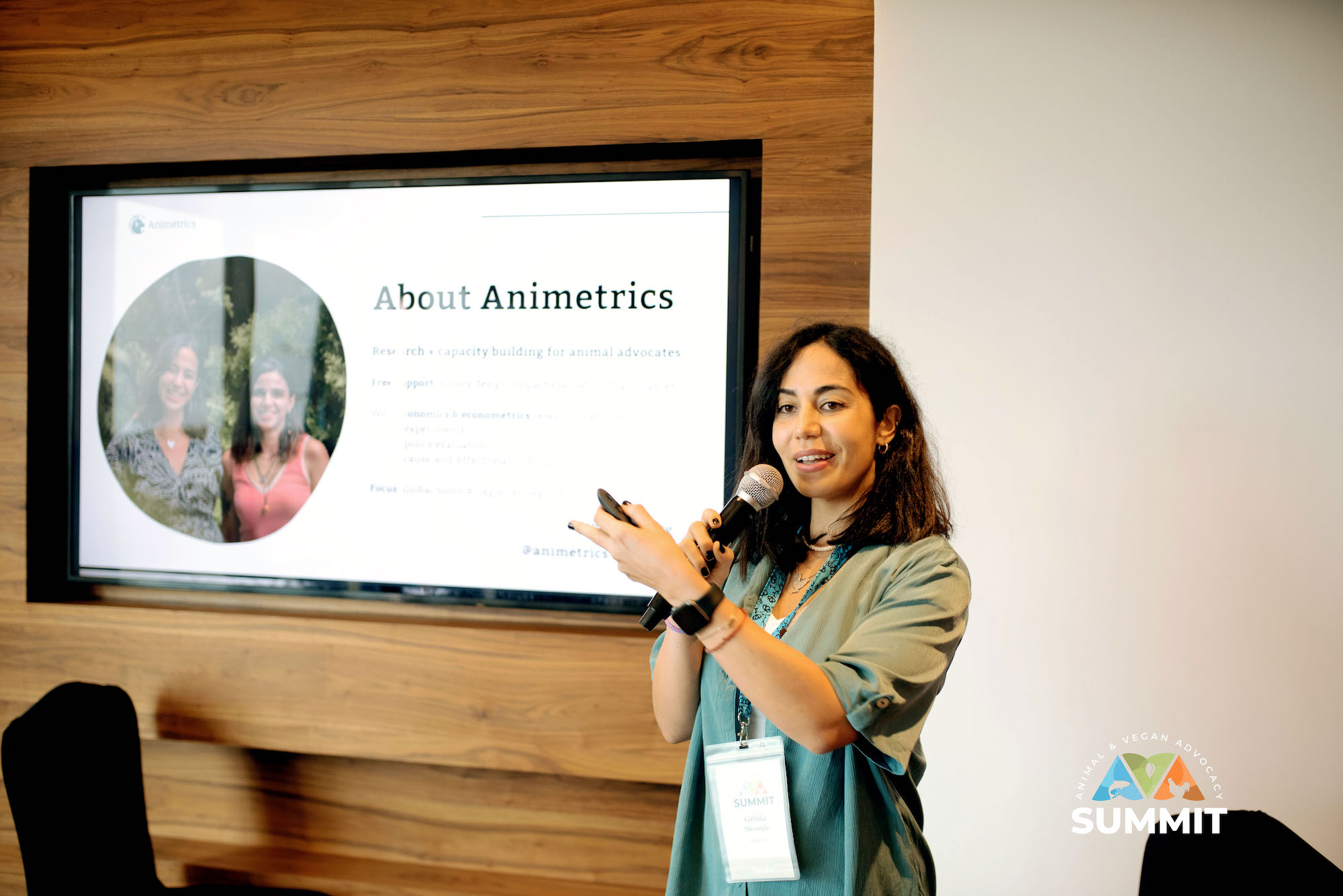
This month, we interviewed Fatma Sueda Evirgen and Gülbike Mirzaoğlu, co-founders of Animetrics, one of ACE’s Movement Grants recipients. Their model is demand-driven: they start with the decisions advocates are actually trying to make, produce rigorous, context-specific research, and stay involved to help turn findings into strategy. As they put it, the aim is “fewer important decisions being made by guesswork, especially in places where animals are numerous, the evidence base is thin, and advocates cannot afford to waste scarce resources.” Let’s get into what they’ve built so far, the challenge of getting research actually used, and why context can decide whether a strategy works at all, below.
Could you introduce Animetrics and the core problem your work is trying to solve?
Animetrics is a research, capacity-building, and implementation-support organization founded by two economists. At its core, we help animal advocacy organizations make more informed decisions: what problems to focus on, which audiences or institutions to engage, which messages to use, and whether a strategy is actually worth pursuing.
Our work is demand-driven: rather than starting with research questions in isolation, we respond to advocates’ concrete needs. We work with them to understand the decisions they are trying to make and the evidence gaps that are holding them back. We then conduct rigorous, context-specific research and stay involved afterwards to help translate the findings into advocacy strategy, policy engagement, corporate outreach, certification discussions, or public communication. In essence, we aim both to produce the evidence advocates need and to make sure it turns into action.
Our economics background shapes how we approach these questions. Economics is fundamentally about how people, organizations, markets, and institutions make decisions and respond to incentives. In animal advocacy, that means asking not only whether two things are related, but what actually changes behavior, which barriers matter most, and how limited resources can be used more effectively. We use surveys, experiments, impact evaluation, and quantitative analysis to investigate these questions. Economists are still relatively uncommon within the animal advocacy movement, so we think this perspective adds something useful.
A major focus of our work is the Global South and Muslim-majority contexts, where advocates often have limited access to locally relevant evidence and may have to rely on research from very different cultural and institutional settings. Muslim communities matter here in particular: halal rules shape the food choices of nearly two billion people, roughly a quarter of the world’s population. Yet, relatively few animal advocacy organizations systematically study Muslim consumers, halal institutions, or what the growth of this food system means for animals and advocacy. For us, this is both a major evidence gap and an opportunity to help advocates develop strategies that are grounded in the realities of the communities and institutions they are trying to reach.
What are some of the biggest wins you’ve had so far?
As a very young organization, one thing we are proud of is simply how much we have been able to build in a short period. Since launching in August 2023, Animetrics has completed 11 studies and 23 capacity-building projects, providing more than 350 hours of research, evaluation, and strategy support to organizations across the movement. Eight of those research outputs were completed in the last 12 months. Our work has included studies on halal and animal welfare, plant-forward diets, plant-based food labelling, farmed-animal attitudes across five Middle Eastern countries, and a 15-country study of Muslim consumers conducted across seven languages.
The wins that matter most are the cases where research has started to inform real decisions. Our five-country research with the Middle East Vegan Society was developed around a concrete need for locally relevant evidence. MEVS later reported using the findings to revise its regional strategy and strengthen its engagement with Talabat. They told us the country-specific evidence increased the credibility and relevance of those conversations, and Talabat subsequently selected restaurants for a pilot with MEVS to expand plant-based options. Similarly, Fundación Veg in Chile used findings from our consumer-confusion experiment when drafting amendments to a restrictive FoodTech bill under legislative review.
Our work on Muslim consumers has also started opening institutional pathways that we did not fully anticipate. In Türkiye, presenting our halal and animal-welfare findings to SigmaCert, an accredited halal certification body, led to further discussions around specific animal-welfare issues and a possible route for engagement with the Ministry of Agriculture. SigmaCert has expressed interest in both continuing the conversation and in sharing the research with assessors and other stakeholders. Our broader Muslim-consumer work has also generated interest from organizations in Türkiye, Indonesia, Nigeria, Ireland, and elsewhere for uses ranging from campaign strategy and consumer education to halal-certifier engagement and future research.
We have also seen encouraging signs that our work is useful beyond direct one-to-one collaborations. A webinar designed to help advocates apply the findings received ratings of 4.5/5 for quality, 4.4/5 for usefulness, and 4.6/5 for clarity; participants identified applications in campaign development, audience segmentation, public communication, policy engagement, and further research. Our research has also been incorporated into teaching at Istanbul University, included in the GFI Europe, Faunalytics, and ICARE research libraries, cited by Rethink Priorities and other researchers, and presented at PHAIR, Fauna Connections, and the EA Unconference.
We are also proud of the quieter wins. Our capacity-building work has supported organizations with survey design, impact evaluation, theory of change, data analysis, and evidence-based advocacy, with partners reporting very high satisfaction and substantial time and resource savings. Internally, we also developed our first Research Implementation Framework and stakeholder-tracking system. That has changed how we define success: not only whether a study was published and reached its audience, but whether someone used it to make a better decision, changed course because of it, or avoided investing in a weaker strategy.
What are the most significant challenges you currently face in advancing your mission?
The biggest challenge is making sure research actually gets used. We learned quite quickly that dissemination and implementation are very different things. Someone downloading a report, sharing it, or even saying they intend to use it does not necessarily mean that the evidence eventually affects a campaign, institutional conversation, or strategic decision. That is why our model has become much more hands-on: involving potential users before the research begins, understanding the decisions they are trying to make, producing more tailored outputs, and following up after publication.
A second challenge is capacity. Demand has grown faster than our small team can accommodate. Our demand tracker records 73 research-support requests and engagements, including 23 completed capacity-building projects, 17 implementation partnerships, and seven direct research partnerships. We were unable to fully support 26 additional requests, primarily because of limited staff capacity. For us, that is encouraging evidence that the need exists, but it also means we have to be very selective about where our time can add the most value.
There are also challenges particular to doing rigorous research across different countries and cultures. Our international Muslim research, for example, required translation and back-translation across seven languages, country-specific wording and religious-context checks, and adaptations when survey providers could not reach the planned number of eligible respondents in some countries. These processes took considerably longer than expected, but they also reinforced why simply transferring research instruments or assumptions from one context to another can be risky.
Apart from those, some of the institutional pathways we work on—policy, halal certification, corporate engagement—are inherently slow and partly outside our control. We can provide strong evidence and support advocates in using it, but we cannot assume that this will immediately translate into policy or welfare change. One of our ongoing challenges is therefore to stay ambitious about what research can contribute while being very disciplined about distinguishing interest, intended use, documented use, and actual outcomes.
How has the ACE Movement Grant helped strengthen Animetrics’ work?
ACE supported us at an important stage of Animetrics’ development. When we applied, we were working on three connected areas of research: Muslim consumers’ understanding of animal welfare in halal production in Türkiye, public attitudes toward farmed animals across the Middle East, and a much larger international study of Muslim perspectives on animal welfare and halal food systems. The grant gave us capacity to move this research forward while also experimenting with a more systematic approach to implementation.
The research itself addressed a particularly neglected area. Halal is not a small niche food system: it shapes food choices for a very large global population and involves institutions such as certification bodies, religious authorities, companies, and governments that can influence both consumer behavior and production practices. Yet when we began this work, advocates repeatedly told us that they lacked basic evidence on questions such as what Muslim consumers believe halal guarantees, which institutions they trust, how they respond to different messages, and where animal welfare fits within those beliefs. ACE’s support helped us investigate those questions much more systematically.
Just as importantly, our ACE application explicitly proposed testing our first formal research implementation approach. During the grant period, we developed a Research Implementation Framework and a CRM-based stakeholder system to track who might use the research, what they need from it, what happens after publication, and where additional support could help. We moved from thinking mainly about “disseminating findings” to asking much more demanding questions about actual use.
That shift has probably been one of the most durable effects of the grant. Our newer projects increasingly begin with a concrete advocacy, policy, corporate, or institutional need and a clearer potential user. We are still learning how to measure longer-term outcomes, but ACE helped give us room to build the systems and experience needed to take research implementation much more seriously.
Why do you think evidence-based animal advocacy is important?
Animal advocacy works with limited time, funding, and organizational capacity, so there is a real cost to getting strategy wrong. A campaign can be compelling and still fail to change behavior. An organization can spend months engaging an institution that has little ability or incentive to act. A message that works in one country can be ineffective, or interpreted very differently, in another. Credibility is also non-negotiable in this movement. When resources are already scarce, a weak strategy can mean limited funding being spent on something that does not deliver the intended result.
For us, evidence-based advocacy is about smarter change. Good data matters, but data alone is not enough. You also need to identify the right species, region, intervention, actors, and moment, and then communicate the evidence in a way that is credible, contextually relevant, and useful to the people who can act on it. If one of those pieces is missing, even a well-intentioned strategy can underperform.
Our economics background shapes this thinking. We tend to ask questions about incentives, trade-offs, causality, and counterfactuals: what is actually changing behavior, what would have happened otherwise, and where limited resources are likely to have the greatest value. Every campaign also has an implicit theory of change—a belief about how an activity will lead to an outcome. Evidence helps us test that pathway instead of assuming it. Reaching people, publishing a report, or running a campaign are important outputs, but they are not the same as outcomes or impact.
And context is central. Context isn’t a detail; it can determine whether a strategy works at all. What works in Berlin may not work in Nairobi, Istanbul, or Jakarta. In Muslim-majority contexts, for example, halal certification bodies, scholars, religious authorities, and different trust dynamics can shape decisions in ways that standard Global North advocacy frameworks may not capture. So evidence-based advocacy does not mean research always confirms what we hoped. Sometimes the most useful finding is that a preferred strategy is weak, another audience is more promising, or we do not yet know enough to scale. Avoiding an ineffective intervention can itself be a valuable outcome.
If you had to share a final message with the ACE audience, what would it be?
We would love to see the movement become more curious about the parts of the world and food system that we still understand poorly. A large share of farmed animals is outside Europe and North America, while locally grounded evidence and advocacy resources are much more limited in many of those regions. Muslim communities are one particularly clear example: roughly a quarter of the global population is Muslim, halal is economically and institutionally significant, yet these contexts remain comparatively under-researched within animal advocacy.
That does not mean taking strategies developed elsewhere and translating them into another language. Sometimes the right message, the barrier, or opportunity is genuinely different. We think one of the most valuable things the movement can do is invest in people and organizations that understand these contexts locally while also giving them access to strong research tools.
We would also encourage researchers to stay close to the people who might use their work. Some of our most useful learning has come after a study was technically “finished”: an advocate explaining why a recommendation was impractical, a certifier showing us a different institutional route, or a partner telling us what evidence they actually need for an upcoming decision.
We would also like evidence-based advocacy to mean something very practical: fewer important decisions being made by guesswork, especially in places where animals are numerous, the evidence base is thin, and advocates cannot afford to waste scarce resources.
Disclaimer/Note: The responses in this spotlight were provided by Animetrics and reflect the organization’s own account of their work.



ACE is dedicated to creating a world where all animals can thrive, regardless of their species. We take the guesswork out of supporting animal advocacy by directing funds toward the most impactful charities and programs, based on evidence and research.